
![[object Object]](https://omo-oss-image.thefastimg.com/portal-saas/pg2026063019375911813/cms/image/138ba837-b50d-4ff3-a73c-2e6a2379c522.jpg "[object Object]")
12
2026
-
04
In-Depth Analysis of Acrel User Substation Full-Scope Monitoring Solution
Author:
Power distribution system upgrades for quality and efficiency enhancement, microcomputer protection establishes foundational safeguards, arc flash protection provides ultimate protection, and integrated automation systems empower operational capabilities
Driven by the dual objectives of carbon peaking and carbon neutrality alongside digital transformation, electricity serves as the lifeline of industrial production. Its safety and operational efficiency directly impact corporate economic benefits and social responsibilities. From 110kV substations to 0.4kV low-voltage distribution rooms, from data centers to petrochemical plants, and from rail transit to aerospace industries, reliable operation of user substations has become an indispensable safety baseline across sectors. How can we achieve "quality enhancement and efficiency improvement" in power distribution? The solution lies in establishing an integrated system architecture: microcomputer protection as the foundation, arc flash protection as the barrier, and integrated automation systems as the control hub.

1. Foundation Construction: Microcomputer Protection – A Precise and Reliable Equipment "Personal Bodyguard"
The safe operation of substations primarily relies on precise protection for each major equipment (transformers, motors, capacitors, and lines). Traditional relay protection systems can no longer meet the modern power grid's requirements for speed response, selectivity, and sensitivity.
Acrel provides a comprehensive range of microcomputer protection devices across multiple voltage levels. The AM6/SE series is designed for integrated main-transformer protection and optical fiber differential protection in 110kV substations, while the AM5SE, AM4, and AM3SE series cover switchgear stations and distribution substations at 10kV and below. Additionally, the AM2SE series features compact designs and resource-efficient configurations specifically tailored for ring main units, forming a complete "protection matrix" that spans from high-voltage to low-voltage systems and from incoming lines to feeder lines.


These devices are not only the "personal bodyguards" of equipment but also feature abundant resources and flexible configurations. Equipped with built-in operation circuits, free configuration of input/output ports, support for USB port upgrades and Ethernet interfaces, and even optional IEC61850 protocol, they perfectly adapt to various scenarios ranging from rudimentary environments to smart grids. In the Xinjiang Ruihong Textile 35kV substation project, by configuring optical fiber current differential protection and high/low backup protection for main transformers, reliable isolation of core loads in the textile park was achieved, providing the first safeguard for production continuity.


Product Qualifications:

2. Bottom Line: Arc Protection – The "Last Line of Defense" for Medium and Low Voltage Systems
If microcomputer protection is considered as "treating existing diseases," then arc protection represents "preventive treatment" aimed at addressing potential hazards before they occur. Medium and low-voltage switchgear, due to the absence of busbar protection, frequent operations, and confined space, constitutes a high-risk area for arc faults. The immense energy generated by arc faults can destroy equipment and cause casualties within milliseconds.
The Acrel ARB6 series arc protection solution is specifically designed to address this critical challenge. It employs dual criteria combining arc detection and overcurrent monitoring, ensuring operational reliability (preventing false trips) while achieving ultra-fast tripping with single-criteria response time <3.8ms and dual-criteria response time <7.8ms, effectively isolating fault points during the initial stages of arc ignition and explosion.
In solution configuration, Acrel demonstrates exceptional flexibility:
Centralized busbar protection system: Designed for entire busbar sections, it collects probe signals and incoming line currents from each cabinet's busbar compartment via the ARB6 host unit to enable regionally selective tripping.
Feeder-type cable room protection: Targeting the high-failure point of cable terminals in outgoing cabinets, the ARB4 device is deployed to enable precise tripping and location within individual cabinets.
Composite full station protection: At Harbin Taiping International Airport Phase II and a semiconductor project in Nanchang, the integrated solution of 'centralized busbar system + feeder cable compartment' was implemented, achieving comprehensive coverage of busbar rooms, trolley rooms, and cable compartments without blind spots.
This not only addresses the shortcomings of traditional differential protection systems—such as complex wiring and inability to protect cable joints—but also ensures the reliability of the device itself through real-time self-diagnostic functions via probes and optical fiber links, truly providing a safety 'safety net'.
3. Empowerment: Integrated Automation System, from "Data Collection" to "Smart Decision-making"
With fundamental protection and monitoring capabilities in place, how can we transform these massive datasets into operational value? The key lies in the substation integrated automation system.
The Acrel Integrated Automation System has evolved beyond being merely a basic backend monitoring software, now functioning as a comprehensive platform that integrates monitoring subsystems, microcomputer five-prevention systems, voltage and reactive power control (VQC), backup auto-transfer control, low-frequency load shedding, and remote dispatching capabilities.
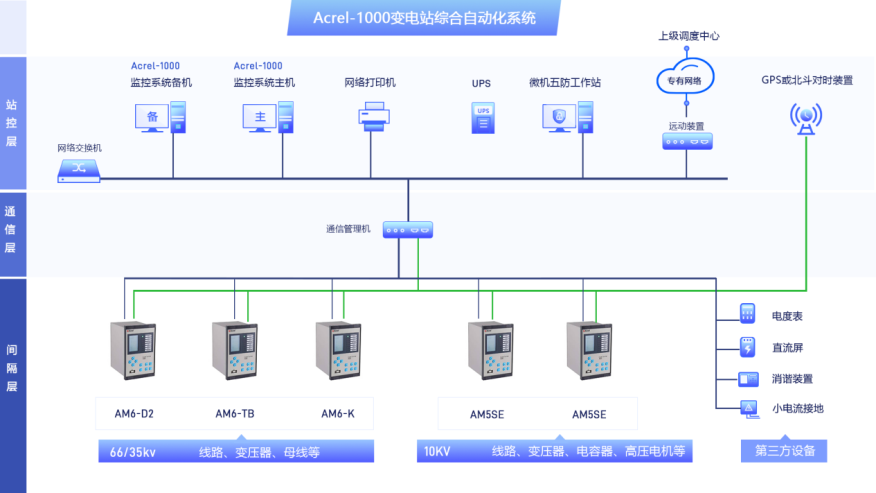
Panoramic monitoring with one-screen station overview: The system not only collects action data and alarm signals from microcomputer protection devices, but also integrates power quality monitoring (including ITIC curve analysis and transient event logging), DC panel monitoring (busbar voltage control and battery status), and environmental auxiliary controls (water ingress detection, temperature/humidity monitoring, SF6 gas levels, and video surveillance). In the Aerospace Information University 35kV project, the integrated automation system manages substation switchgear while aggregating data from three medium-voltage distribution units and multiple power distribution rooms across the campus via fiber-optic networks to the "University EMS Energy Management Platform," achieving centralized monitoring from 35kV feeders to residential power consumption through a unified dashboard interface.


Intelligent control with one-touch sequential operation and five-prevention linkage: Through deep integration of the microcomputer-based five-prevention system with the integrated automation system, logical interlocks are implemented to prevent operational errors. The system also supports "one-touch sequential control" functionality, automating complex switching procedures into programmed workflows to significantly enhance operational efficiency and reduce human error risks. In the 10kV project at Shaanxi Provincial Public Security Department Data Center, logical programming of AM5 series protection devices enabled sophisticated "grid power-diesel generator" stepwise switching strategies, effectively mitigating load surges and ensuring seamless transition of critical data center loads.

Cloud-based dispatching integration addresses data silos: The system supports multiple protocols including IEC60870-5-101/104 and IEC61850, enabling seamless connectivity with higher-level dispatch centers. During the Sichuan Galaxy Jianhua 110kV substation upgrade project, Acrel not only completed comprehensive replacement of secondary equipment but also collaborated with the power supply bureau to implement secondary security reinforcement and dispatch synchronization protocols. These measures ensured reliable data transmission and stable control capabilities, transforming the user substation into a trusted node within the power grid dispatching framework.
4. Empirical Evidence: Deep Implementation Across Industry Scenarios
Theoretical concepts must be validated through practical implementation. From the extreme cold environment of a 66kV substation in Heilongjiang to scorching overseas data centers; from PetroChina facilities with stringent explosion-proof requirements to information universities demanding exceptional reliability; from steel mills and coal mines experiencing drastic load fluctuations to semiconductor wafer fabs sensitive to power quality – Acrel's integrated solution combining "microcomputer protection + arc protection + integrated automation systems" has proven its reliability in thousands of projects worldwide.
At Sichuan Galaxy Jianhua, we assisted chemical enterprises in achieving intelligent transformation of aging substations, meeting the requirements for the commissioning of dual main transformers and dispatching data upload. At a pharmaceutical company in Changzhou, we established a comprehensive energy efficiency management system spanning from 35kV to 0.4kV for the biopharmaceutical park. At the Xinjiang water supply project pumping station, we constructed a secure firewall for large-scale water facilities with "unmanned operation and minimal staffing" through 8 main units and 189 sensors.
Epilogue
Quality enhancement and efficiency improvement are not empty slogans, but are realized through precise actions, rapid tripping mechanisms, and multi-layered protective measures. Acrel is committed to strengthening safety foundations with microcomputer protection systems, plugging critical vulnerabilities through arc flash protection, and empowering data intelligence via integrated automation systems. We provide comprehensive monitoring solutions covering all scenarios and full lifecycle management for user substations at 110kV and below voltage levels.
Make electricity safer, management simpler, and energy more efficient. Choose Acrel to safeguard your power system.
Key words:
Related news
Newsletter
Sign up our newsletter to get update news and article about company.